

Network penetration testing
Network Penetration Testing
See what an attacker could actually reach on your network. We map your exposure and test the paths that matter, from the public internet and from inside your network. Every engagement is delivered by experienced professionals and testing is always performed in the United States.
What is network penetration testing?
Network penetration testing, also called infrastructure penetration testing, is an authorized, scoped test of your networks and the systems on them. A tester maps what is exposed, validates weaknesses by hand, and confirms what an attacker could actually reach, from the public internet, from inside your network, or both. You get a report of real, validated findings with practical remediation guidance, rather than raw scanner output.
External network testing
- What it tests
- Your internet-facing systems and services, the authentication exposed to the internet, and what an outside attacker could actually reach from the public internet.
- What it finds
- Exposed services with known or misconfigured weaknesses, login points open to the internet, and paths from the outside toward internal systems.
- When to choose it
- You want to understand your exposure from the internet, for example after adding new public services, changing firewall rules, or moving systems to a new provider.
Internal network testing
- What it tests
- How far an attacker could move from an assumed foothold inside the network, such as a connected device or VPN account, and whether segmentation holds between environments and sensitive systems.
- What it finds
- Credential exposure and reuse, gaps in segmentation, and paths toward high-value systems and data.
- When to choose it
- You want to know what happens if a device, account, or user is compromised, or you need to check that sensitive environments are separated as intended.
Not sure which perspective fits? Tell us about your environment and we will help you choose.
Testing methodology
We use public reference frameworks such as the Penetration Testing Execution Standard (PTES) and NIST SP 800-115, the technical guide to information security testing, so your team can follow how the work was done. We describe findings against well-known industry frameworks where it helps your team understand attacker behavior, without turning the report into a mapping exercise.
Because scope and timing are agreed up front, a network test differs from an open research program. Seepenetration testing vs bug bountyfor how the two compare.
- Discovery and enumeration: we identify the live hosts, open ports, and services in the agreed ranges, using tools such as Nmap.
- Service identification: we confirm what each exposed service is, its version, and how it is configured.
- Manual validation: a tester checks each potential weakness by hand, so the report reflects confirmed issues rather than raw scanner output.
- Controlled exploitation: where agreed in the rules of engagement, we carefully confirm impact within the agreed scope and testing windows.
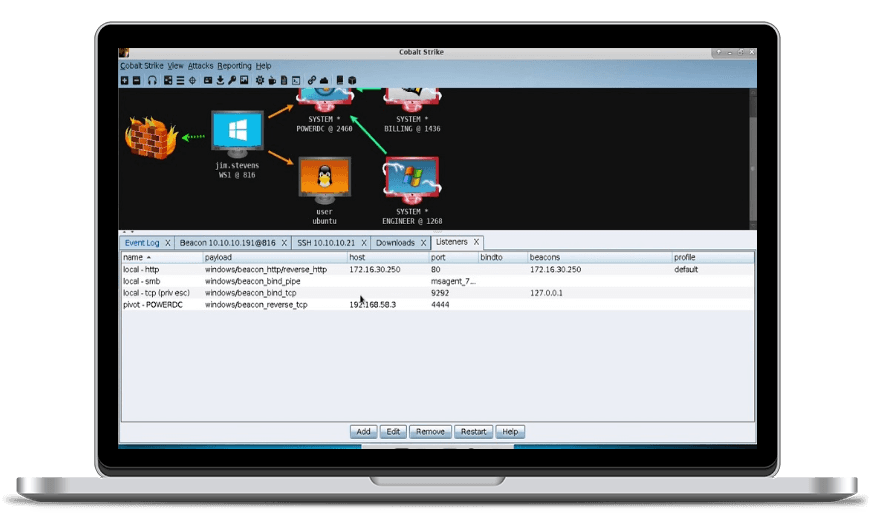
- Lateral movement, if agreed in scope: we check whether a foothold could be used to move toward other systems or sensitive data.
Our process
- 1
Scope
We agree on the ranges, sites, and internal or external perspective before testing begins.
- 2
Access and setup
For internal testing we arrange a foothold, such as a connected device or VPN account.
- 3
Testing
We map exposure and test real attack paths, confirming impact rather than reporting raw scanner output.
- 4
Reporting
You receive findings with steps to reproduce, business impact, severity, and remediation guidance.
- 5
Readout and retest
We walk through the findings with your team. Retest terms set in the statement of work.
What a good report includes
Enough detail to reproduce and fix, and a summary leadership can follow.
- Each finding with the steps and conditions to reproduce it.
- Business impact described in plain language.
- Severity rated with a documented, consistent method.
- Practical remediation guidance for your team.
- An executive summary that reflects the actual findings.
Scoping checklist
These questions define coverage so both sides know what is included. This is about clarity, not a checklist for choosing a vendor.
- External, internal, or both perspectives.
- The IP ranges, sites, and systems in scope.
- Any systems that must be excluded or handled carefully.
- How internal access will be provided.
- What is explicitly out of scope.
- Test windows and any availability constraints.
- Who to contact if we confirm a critical-severity issue mid-engagement.
What is included
Beyond the testing itself, you get the deliverables your team needs to prioritize and fix what we find.
- Scoped testing of the external and/or internal ranges, sites, and systems we agree are in scope, with tooling used to widen coverage.
- A written report with steps to reproduce, business impact, severity, and remediation guidance.
- A readout after delivery to walk through findings and answer questions.
- Retest terms set in the statement of work.
Frequently asked questions
Short answers to common questions about scoping a network penetration test.
Internal or external testing: which do we need?
External testing shows what an attacker could reach from the internet. Internal testing shows how far an attacker could move after gaining a foothold inside your network. Many organizations start with the perspective that matches their biggest concern and add the other later, and some test both in one engagement. We can help you choose during scoping.
Will testing disrupt our network?
Testing is planned to keep the risk of disruption low. Testing windows, rate limits, and any fragile systems to exclude or handle carefully are agreed in scope before testing begins. If we confirm a critical-severity issue during testing, we contact your named contact right away rather than waiting for the report.
What do you need from us?
The IP ranges, sites, and systems in scope, written authorization to test them, and a named contact for the engagement. For internal testing, we also align on how access will be provided. For cloud or hosted assets, we need to follow the provider's testing policy, and authorization has to come from whoever controls each asset.
How is it different from a vulnerability scan?
A vulnerability scan is an automated check that lists possible issues. A network penetration test uses tools to widen coverage, then a tester validates findings manually and, within the agreed rules of engagement, confirms what an attacker could actually reach. That reduces false positives and shows the impact we could confirm.
How long does a network penetration test take?
It depends on scope, such as the number of ranges and sites, whether the test is external, internal, or both, and any testing windows. We agree on a timeline during scoping.
Is a network penetration test a compliance certification?
No. A network penetration test is not a compliance certification. It shows what was found in the systems and perspectives that were agreed in scope, and it can be one input to a broader security program.

Scope a network test
Tell us about your environment and we will follow up with next steps.